
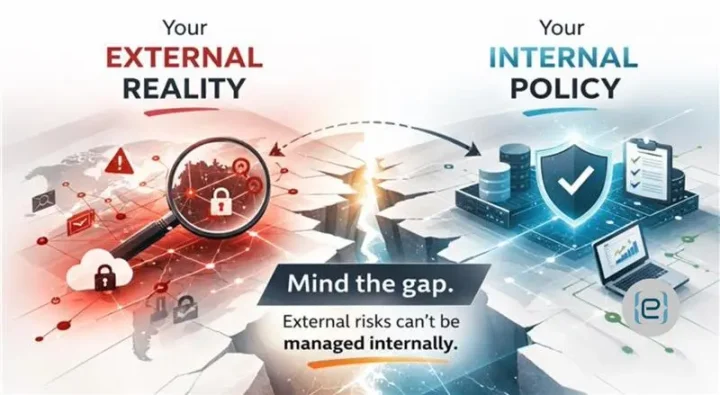

Most companies believe they understand their security posture. They have policies. They have controls. They run scans. They pass audits. And yet — breaches still happen.
Not because organizations ignore security, but because they’re often looking inward while attackers start from the outside. There is a gap between internal policy and external reality. And in that gap? That’s where risks like Shadow IT, forgotten subdomains, and exposed cloud resources lurk.
Security From the Inside Out
Inside the network, everything looks organized.
Systems are documented. Access is managed. Vulnerabilities are tracked. Compliance frameworks outline what should be protected and how often it should be reviewed.
But attackers don’t begin with your documentation. They begin with what they can see from the outside.
Forgotten subdomains. Old cloud resources. Test environments left exposed. Services that no one remembers owning.
Many incidents don’t start with a sophisticated intrusion — they start with something simply reachable. The Equifax breach of 2017 is often discussed as a patching failure, but the real lesson is visibility. The exposed web application wasn’t mapped against internal patching policies. The entry point wasn’t inside the company’s awareness — it was outside it. Over 147 million records were compromised as a result.
The question isn’t only whether your systems are well-managed. It’s whether your external exposure is in your field of view at all.
Why Traditional Security Misses the Problem
Most security programs are designed around known assets.
Tools scan systems that are registered. Teams monitor infrastructure they manage. Compliance validates environments that are documented.
But external exposure doesn’t follow organizational boundaries. It follows DNS records, integrations, vendors, and history.
Over time, every organization accumulates technology residue:
- Pilot projects that never got removed
- Vendor integrations that remained accessible
- Cloud services created outside normal processes
- Infrastructure that outlived the people who deployed it
From the inside, these don’t exist. From the internet, they do.
This is where many teams experience alert fatigue — endless findings but little context about which ones actually matter to the business. According to Verizon’s 2023 Data Breach Investigations Report, 74% of breaches involve external exposures or misconfigurations that bypass internal controls. Volume without attribution isn’t security. It’s noise.
A Different Way to Look at Risk: eMazzanti’s Assurance Framework
Closing the gap doesn’t require more alerts. It requires perspective.
Security has to begin with external observation — understanding what the organization looks like from the same vantage point an attacker uses — and then connecting that view back to operational reality. At eMazzanti, we treat this as an ongoing operational process, not a one-off scan.
Our suite of services — managed IT, cybersecurity, cloud migrations, and compliance tools — delivers clear, business-contextual insights that tie external findings to your internal policies. Here’s how it works in practice:
For the Proactive IT Manager (Managed Network Assessment & Dark Web Monitoring): Our 24/7 monitoring and dark web scans detect dangling DNS records or leaked credentials in real-time, mapping them to your access policies. We’ve helped clients spot and secure forgotten subdomains before they became hijack targets — no disruption, no agents required.
For the Compliance-Focused Executive (PCI & Regulatory Alignment): With PCI DSS-compliant tools and eDiscovery capabilities, we provide external audits that flag data exposures and subdomain risks, aligning with SOC 2’s Trust Services Criteria and other regulatory frameworks. In one case, a finance client avoided audit findings entirely by integrating our email governance tools.
For the Risk-Aware Analyst (Endpoint & Ransomware Defenses): Our vulnerability management cross-references threat intelligence with actively exploited vulnerabilities, filtering noise from real, weaponized threats. Paired with AI-driven email filtering, it enforces phishing policies externally — stopping breaches before they reach the inside.
For the Growth-Oriented Leader (Cloud & Holistic Dashboard): During Microsoft 365 migrations or cloud setups, our monitoring integrates people, technology, and supply chains into a single operational view. This ensures external threats don’t cascade internally, supporting HIPAA, GDPR, and broader compliance requirements as the business scales.
Together, these services answer the key question: does this exposure matter to the business, and what should we do about it?
What Changes for Teams
When organizations close this visibility gap, the conversation shifts.
IT leadership moves from maintaining lists to understanding ownership — unexpected assets become managed decisions, not surprises. Compliance teams prepare earlier because risks are discussed before audits, not during them. Security teams spend less time on theoretical findings and more time addressing reachable issues. Business leaders gain clearer explanations — risk is no longer technical jargon but an operational story.
And culturally, something important changes: security becomes proactive instead of investigative. Teams recognize issues as part of normal operations, not as post-incident discoveries.
We’ve seen this transformation across industries. A healthcare provider aligned HIPAA policies with external scans to pass audits without last-minute scrambling. A manufacturer used our ransomware defenses to neutralize supply chain threats before they escalated internally.
From Assumption to Understanding
Many organizations aren’t insecure because they lack tools. They’re insecure because they lack a complete picture.
Internal security answers: Are our systems configured correctly? External visibility answers: Which systems actually exist to the outside world?
Only when both views align does security become predictable — and proactive.
Because attackers don’t care about your internal policy. They care about your external reality.
At eMazzanti, we bridge that divide with services that scale from small businesses to enterprise. Ready to align your worlds? Contact us today.